File: //opt/nerfstudio/docs/nerfology/methods/nerfplayer.md
# NeRFPlayer
<h4>A Streamable Dynamic Scene Representation with Decomposed Neural Radiance Fields</h4>
```{button-link} https://lsongx.github.io/projects/nerfplayer.html
:color: primary
:outline:
Paper Website
```
```{button-link} https://github.com/lsongx/nerfplayer-nerfstudio
:color: primary
:outline:
Nerfstudio add-on code
```
[](https://www.youtube.com/watch?v=flVqSLZWBMI)
## Installation
First install nerfstudio dependencies. Then run:
```bash
pip install git+https://github.com/lsongx/nerfplayer-nerfstudio.git
```
## Running NeRFPlayer
Details for running NeRFPlayer can be found [here](https://github.com/lsongx/nerfplayer-nerfstudio). Once installed, run:
```bash
ns-train nerfplayer-ngp --help
```
Two variants of NeRFPlayer are provided:
| Method | Description |
| --------------------- | ----------------------------------------------- |
| `nerfplayer-nerfacto` | NeRFPlayer with nerfacto backbone |
| `nerfplayer-ngp` | NeRFPlayer with instant-ngp-bounded backbone |
## Method Overview
<br>
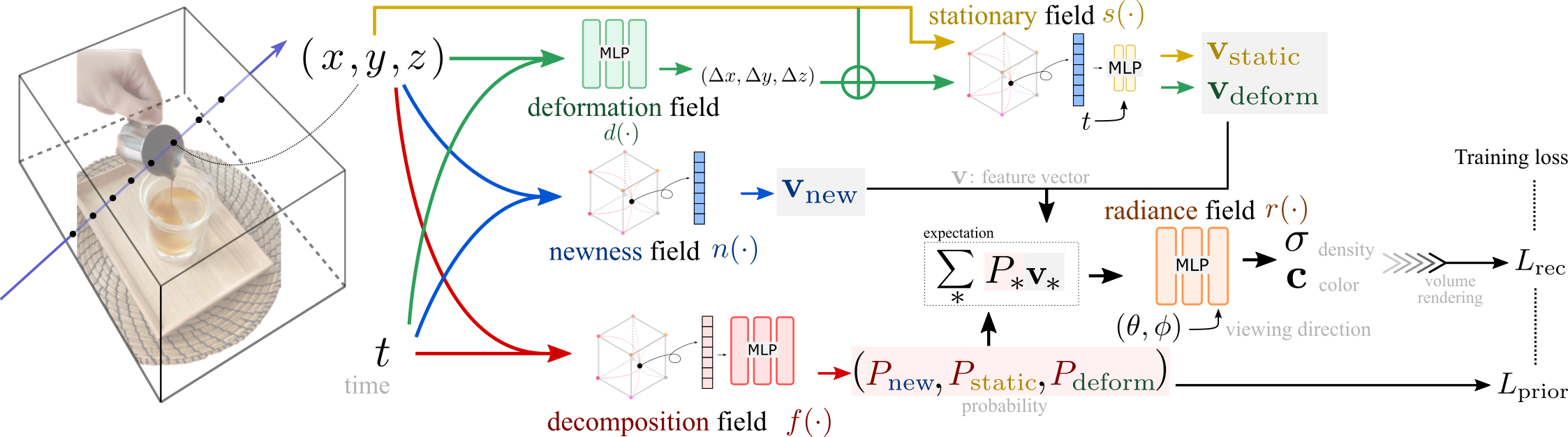
First, we propose to decompose the 4D spatiotemporal space according to temporal characteristics. Points in the 4D space are associated with probabilities of belonging to three categories: static, deforming, and new areas. Each area is represented and regularized by a separate neural field. Second, we propose a hybrid representations based feature streaming scheme for efficiently modeling the neural fields.
Please see [TODO lists](https://github.com/lsongx/nerfplayer-nerfstudio#known-todos) to see the unimplemented components in the nerfstudio based version.